|
JOHN FALCONER (fl. 1685-1692) Cryptomenysis Patefacta; or,
The Art of Secret Information Disclosed without a Key. London,
Daniel Brown, 1685.
John Falconer was a distant relative of David Hume's family, and a
supporter of King James II. Held in high regard by Philip Thicknesse
(1719-1792), the works of Falconer on secret writing and the conveying of
concealed messages include Cryptomenysis Patefacta and Rules
for Explaning and Decyphering all Manner of Secret Writing (London,
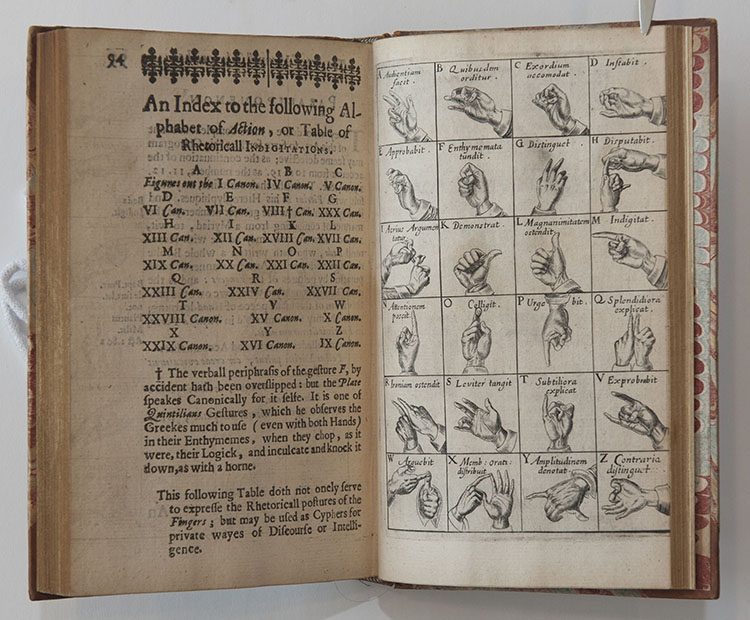
1692). Of special interest in Cryptomenysis is a section on
semeiology, which Falconer defines as "methods of secret information by
signs and gestures." Among such signs and gestures Falconer includes
Egyptian heiroglyphs and finger alphabets (dactylology). A brief analysis
of selected writings of Johannes Trithemius (1462-1516) concludes the work.
Cryptomenysis has been greatly influenced by Gaspar Schott
(1608-1666) and John Wilkins, Bishop of Chester (1614-1672). (Alston III
(2): 787; Galland p. 62; Westby-Gibson p. 64; Wing F296)
ATHANASIUS KIRCHER (1601-1680) Polygraphia Nova et
Vniversalis ex Combinatoria Arte Detecta. Rome, Varese,
1663.
This work of the German scholar and mathematician is based
principally on the writings of Johannes Trithemius. Joaquín
García Carmona and others see also the influence of Blaise de
Vigenère (1523-1596), whose multi-alphabet cipher seems to have
been transformed by Kircher into a numerical cipher. Of special interest
in Polygraphia is part 1, where Kircher proposes a system of
pasigraphy, or universal writing, employing numerals to stand for words of
similar meaning in Latin, Italian, French, German, and Spanish. Parts 2
and 3 deal with cryptographic methods now largely abandoned. (Galland p.
102-103; Guyot p. 426; Stojan 35; Westby-Gibson p.105)
FRANCESCO LANA TERZI (1631-1687) Prodromo all'Arte
Maestra. Brescia, Rizzardi, 1670.
 Italian
naturalist and physicist,
Lana Terzi deals principally with problems of aeronautics, mechanical
engineering, and microscopy, including a section on the construction of
flying machines. Of special note are the opening sections,
wherein alphabet and numerical ciphers are described.
Prodomo includes an early illustrated description of a
cipher employing musical notation, a method initially proposed by
John Wilkins, Bishop of Chester, in his Mercury; or, The
Secret and Swift Messenger (London, 1641). Lana Terzi also
proposes methods of writing for the blind, and of teaching the
deaf to speak, which he himself put into practice. (Galland p. 107; Guyot p.
124; LC 84:20)
FRANCISCO DE PAULA MARTI (1762-1827) Poligrafía,
ó Arte de
Escribir en Cifra de Diferenter Modos. Madrid, Imprenta de Sancha,
1808.
Drawing on the work of Trithemius and Kircher, among
others, Martí here outlines a variety of ciphers. These include
numerical and alphabet substitution ciphers, and imaginary alphabets. The second half of the work deals with invisible writing.
Martí describes methods of making readable texts where either the ink
has faded, or the messages were written in invisible ink. (Palau 8:237)
GIOVANNI BATTISTA DELLA PORTA (1535?-1615) De Fvrtivis
Literarvm Notis. Naples, Joa. Maria Scotus, 1563.
 Along with
Trithemius and Vignère, Porta is generally regarded as one of the
founders of modern cryptography. This first edition of his encyclopaedic
work on the subject includes historical sections on deciphering, and on
cryptography in the ancient world. Porta is know chiefly for his invention
of a series of twelve alphabet ciphers in which letters of the second half
of the alphabet are made to stand for letters of the first half, a key
word indicating what substitutes are used. The earliest know cipher of its
kind, its chief value lies in its compactness and convenience to prepare.
Porta's work may have been known to Vigenère, and is acknowledged by
Matteo Argenti (fl. 1610), cryptographer of the Papal States, as the chief
source of his own work. Porta is also known for proposing the sympathetic
telegraph, a device whereby a magnetized needle may be used to activate
another at a distant point. (Adams P1924; Galland p. 146-147; Guyot p.
435; Stojan 652; Westby-Gibson p. 181)
CRYSTOBAL RODRIGUEZ (1677?-CA. 1735) Bibliotheca Universal
de la Polygraphía Español. Madrid, Antonio Marín,
1738. This work is generally considered to be the first
complete study of cryptography
and palaeography in Spain. It consists chiefly of numerous tables of
alphabets and signs, and of facsimiles of scripts and documents written in
abbreviated forms. Rodriguez, archivist of the Cathedral of Avila and
commissiner of the Inquisition at Valladolid, has inserted many
transcriptions and explanatory material. The lengthy and erudite
introduction by Blas Antonio Nassarre y Ferriz (1689-1751) deals with
writing in Spain prior to the Arab invasion in 711. (Bonacini 1543;
Cotarelo 943; Galland p.157)
PHILIP THICKNESSE (1719-1792) A Treatise on the Art of
Decyphering,
and of Writing in Cypher. London, W. Brown, 1772. This
work deals primarily with the theory of secret writing rather that the
practical applications of cryptographic methods. Thicknesse notes that
he was moved to write this treatise by a comment concerning the neglect of
the art of deciphering in the Advancement of Learning by Francis
Bacon (1561-1626), who had proposed a system of cryptography based on the
so-called double cipher. Of special interest is Thicknesse's extensive
section on the use of a harmonic alphabet, wherein musical notes are made
to represent letters of the alphabet, elaborating in particular on the
views of Bishop John Wilkins (1614-1672). Of the various methods for
conveying secret messages, Thicknesse considers the harmonic alphabet to
be the least liable to suspicion. (Alston III (2): 841; Galland p.179;
Westby-Gibson p.217)
JOHANNES TRITHEMIUS (1462-1516) Polygraphique et Vniverselle
Escriture Cabalistique. Paris, Jacques Kerver,
1561.
Begun at the request of the Duke of Bavaria, this very early treatise
on cryptography by the Abbot of Sponheim was probably first published in
1518, although the dedication is dated 1508. Having been accused of
dealing in black magic, Trithemius was at first reluctant to publish the
work, and this may account for the discrepancy in dates. The work
describes both substitution and transposition ciphers. Polygraphie
became the basis of much subsequent work in cryptography. First written in
Latin, the present edition of 1561 is the French translation of Gabriel de
Collange (d. 1572). Collange has also designed for this edition thirteen
volvelles for use in applying various types of ciphers. This translation
became the object of a well-known plagiarism when, in 1620, Dominique de
Hottinga, a Frisian, published Polygraphie under his own name.
(Galland p. 184; Guyot p. 428; LC 149:567; Stojan 16)
JOHANNES TRITHEMIUS
(1462-1516) Steganographia. Nuremberg, Joh.
Friedrich Rüdiger, 1721.
Although he first published this work at Lyons in 1531,
Trithemius apparently completed Steganographia sometime in 1500,
and the work became known prior to the publication in 1518 of
Polygraphiae, with which it is often confused. In it the Abbot of
Sponheim gives 55 different kinds of ciphers. He also delineates numerous
methods for putting messages into codes. Because of his use of bizarre
terms and characters in the work, Trithemius became suspect of dealing in
black magic. This edition of Steganographia includes extensive
explanations of Trithemius' work by Wolfgang Ernst Heidel (fl. 1676-1721),
one of several apologists for the book. (Galland p.182; LC 149:567; Stojan
657a)
BLAISE DE VIGENERE (1523-1596) Traicté des Chiffres; ou,
Secretes Manieres d'Escrire. Paris, Abel L'Angelier,
1586.
Regarded as one of the founders of modern cryptography, Vigenère
deals principally with the history of cryptography, and the processes of
cipherment. The work includes the first description of the multi-alphabet
cipher, or "alphabet square." Although some writers consider this to be
Vigenère's invention, more likely it was devised by Leone Battista
Alberti (1404-1472) or one of the early cryptographers of the Papal States.
In any case, the alphabet square is generally regarded as the most
perfect of the simpler polyalphabetical substitution ciphers. Also contained
in the Traicté des Chiffres is the first known European
representation of the Japanese language. (Adams V743; Galland p.193;
Stojan 21b)
Return to the introductory page.
Special Collections Home
|