Just as the latest photographs from space awe us today, accounts of 19th century scientific expeditions brought distant wonders home to Americans. With maps, engravings, and color plates, exploration accounts represent the highest quality in government printing. Opening the West was of immediate interest; government funding of scientific maritime expeditions did begin not until 1838. Many expeditions were justified in commercial terms, but fortunately most also included scientists and skilled observers. But a sampling of this rich literature.
A widespread belief in minimal government coupled with a suspicion of scientific research as the idle pastime of the wealthy hampered Congressional funding. However, by the century's end government expeditions had established routes across the American West, circled the globe, and charted the heavens. With the science controversy settled in favor of an active role for government, two agencies were at work systematically mapping the nation and recording its resources.
As the 19th century opened, Thomas Jefferson persuaded a reluctant Congress to provide $2500 for Lewis and Clark's exploration of the newly purchased Louisiana Territory. Beyond merely finding a route to the Pacific, Jefferson's instructions called for collecting botanical, zoological, geologic, meteorological, astronomical, linguistic, and ethnographic data. As they broke winter camp at Fort Mandan, preparing to continue to the Pacific coast, Lewis & Clark dispatched their first reports to President Jefferson. Journals, 67 mineral samples, and 60 dried plants were packed in tin boxes. "By the return of this canoe, I shall send you my journal, and some one or two of the best kept by my men. I have sent a journal, kept by one of the sergeants, to Captain Stoddard, my agent at St. Louis, in order, as much as possible, to multiply the chances of saving something." Much of their report evaluated the native populations in terms of potential trading relationships.
John C. Fremont was commissioned by the War Department's Topographical Bureau in 1842 to survey a route from Missouri to the Oregon Territory. Fort Laramie, established in 1834 as a fur trading post, was the gateway to the Rocky Mountains became an important stopping point on the Oregon Trail.
In 1847 Congress directed Henry R. Schoolcraft to compile an exhaustive history of the Indian tribes of the United States. The first volume of this lavishly illustrated work, Historical and Statistical Information Respecting the History, Condition and Prospects of the Indian Tribes of the United States, appeared in 1851. The sixth and concluding volume appeared in 1857. Schoolcraft also published the first survey of the geography, geology, and mineralogy of Ozarks region; discovered the source of the Mississippi River; and supplied Henry W. Longfellow with Native American legends for his epic poem, "The Song of Hiawatha." Ethnographic studies would become an important bureau within the Smithsonian in the late 19th century.
The Army Appropriation Act of March 1853 directed Secretary of War Jefferson Davis to survey four possible routes to the Pacific. An ill-fated party under Captain John W. Gunnison explored a route along the 38th and 39th parallels, or the Cochetopoa Pass route, advocated by Missouri Senator Thomas Hart Benton. After Gunnison's death at the hands of hostile Indians, Lt. Edward G. Beckwith continued the survey and submitted a report including this lithograph. The surveys showed that a railroad could follow any one of the routes; however sectional disagreements prevented Congressional support for a transcontinental railroad until 1862.
In 1857, Lieutenant Ives was assigned the task of determining the extent to which the Colorado River could be navigated. The 50-foot iron steamer he purchased in Philadelphia was disassembled and taken by ship and rail to the mouth of the Colorado River for reassembly. Besides navigating more than 400 miles up the Colorado River, the Ives expedition collected geologic, meteorological, astronomical, botanical, zoological, and ethnographic data. Two years were required to prepare his Report upon the Colorado River of the West Explored in 1857 and 1858 with its accompanying maps and illustrations.
The scientific maritime expeditions mounted by European nations, beginning with James Cook's first voyage in 1768, revolutionized human understanding of the natural world and brought glory to their sponsors. American navigators were making significant voyages of their own, but these were private affairs. The precious information they put in their logs was considered to contain business secrets, and the logs were routinely destroyed when they returned home. As the fame and import of scientific voyages grew, an increasing number of Americans ached to see their own nation make a public contribution to the expansion of human knowledge and win renown.
After a decade of lobbying a reluctant Congress, Charles Wilkes, commanding six naval vessels, set sail August 18, 1838 on a five year voyage that would take him to Tierra del Fuego, in sight of Antarctica, to Australia, Fiji, Hawaii, the Oregon coast, San Francisco, Manila, Singapore, and Cape Town before returning to New York in 1842. It had taken over a decade to secure funding for this first scientific maritime expedition sponsored by the U.S. government. In hindsight, Wilkes display of the American flag on the Oregon coast came at a crucial time during negotiations with Great Britain to delineate our northern boundary.
On August 16, 1849, Lieutenant James M. Gilliss, U.S. Navy sailed for Santiago, Chile with instruments for an observatory. His observations of Mars and Venus refined the measurement of solar parallax, used to calculate the mean distance to the sun.
Gilliss entered the Navy at the age of fifteen, then took up astronomy when directed to conduct simultaneous observations while the Wilkes Expedition (1838) was abroad. Gilliss planned the Naval Observatory and was an original member of the National Academy of Sciences. In 1830 the Navy established a Depot of Charts and Instruments for the care of its charts and navigational instruments. Regular astronomical observations began with Gilliss' work in 1838. The observatory was formally established in 1842; its publications included, Reports on Observations of Encke's Comet During Its Return in 1871.
In 1852 Lieutenants William Lewis Herndon and Lardner Gibbon were instructed to traverse South America from Lima, Peru to the mouth of the Amazon River. While climbing over the Andes Mountains to reach the headwaters of the Amazon, they inspected the Peruvian silver mines from dating to the 17th century. Besides the Naval requirement to map distance and navigability on the Amazon River, Herndon carefully observed the flora and fauna as well as the native peoples of the Amazon Basin. Popular demand for his highly readable report exceeded the normal few hundred copies printed for Congress; in the first year the Secretary of the Navy ordered an additional 30,000 copies. Although colored by the attitudes and prejudices of his times, Herndon's best-seller is still in print today.
Japanese ports had been closed for more than two centuries to all but a few Dutch and Chinese traders. The United States not only wanted to establish trade with Japan but needed ports at which our commercial whaling fleet could replenish coal and supplies. In March 1852, President Millard Fillmore ordered Commodore Matthew Perry, commanding the Navy's East India Squadron, to establish diplomatic relations with Japan. The Treaty of Kanagaw, signed March 31, 1854, allow U.S. vessels access to the ports of Shimoda and Hakodate and provide Japanese assistance for shipwrecked U.S. seamen. It also led directly to Japanese contact with other Western nations and ultimately to the Meiji Restoration of the Emperor and the modernization of Japan. While primarily a diplomatic mission to establish trade relations, Perry's expedition also collected considerable information about Japanese culture and history.
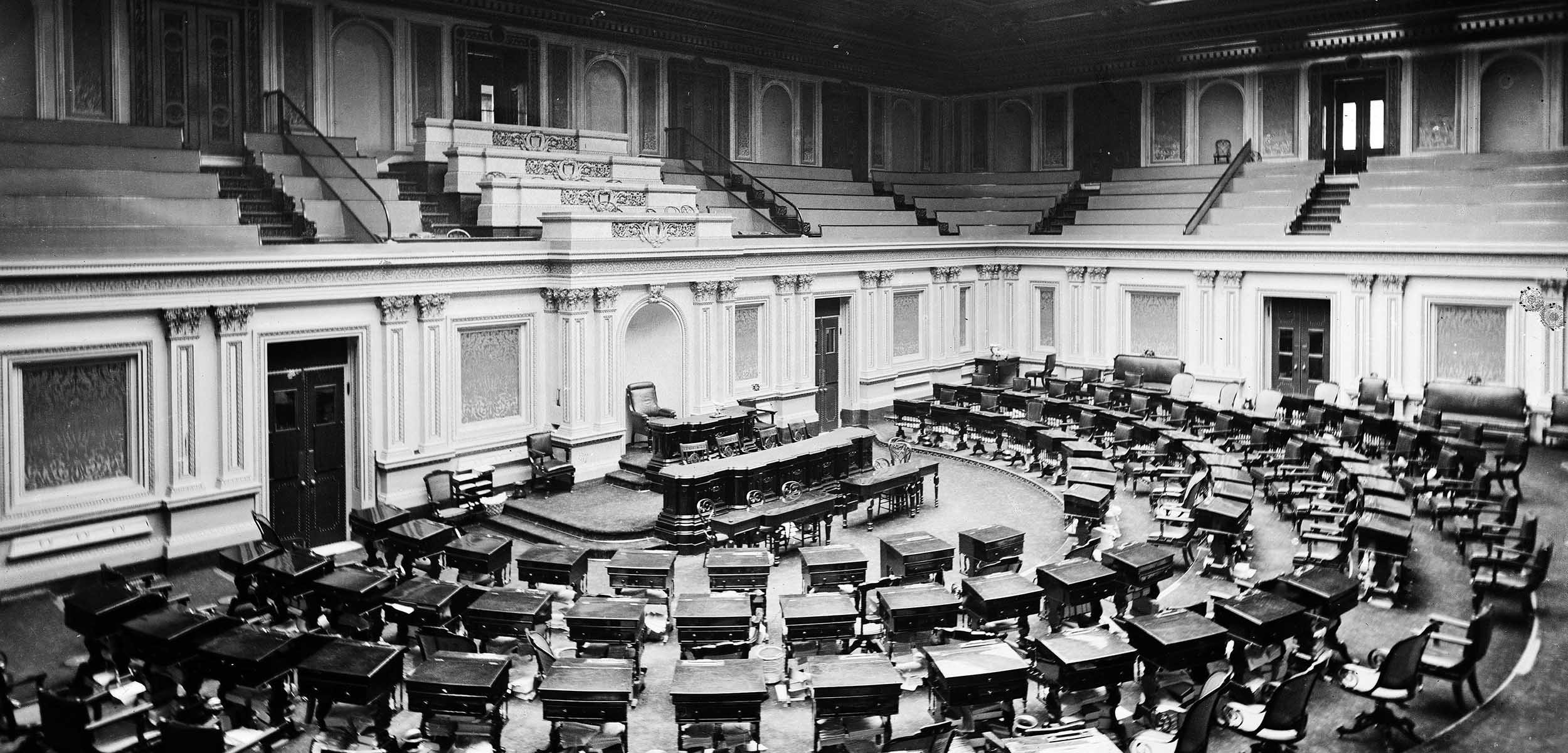
Seeking to curb the growing executive branch after the Civil War, Congress limited public documents to those "printed on the authority of Congress." Except for annual reports and a few approved titles included in the Serial Set, most executive agency documents were excluded from the depository program. As the initial exploration of the vast American continent gave way to more detailed mapping and analysis of the nation and its resources, scientific documents were often flashpoints in this printing controversy.
Representative (later President) James A. Garfield contributed to this debate in 1879, "In the main, the framers of our Government trusted science to the same jurisdiction to which they intrusted religion. With the single exception of one clause in the Constitution authorizing Congress to promote science by granting copyrights and patents, the chief support and maintenance of science are left, and I think wisely left, to the voluntary action of our people; and this was done, not in the interest of liberty alone, but in the interest of science itself." Even research with direct economic impact, such as mapping and charting natural resources, was believed by opponents as best left to private enterprise. In 1885 Representative Hilary Herbert of Alabama introduced legislation to prevent the U.S. Geological Survey "from paleontological discussions, and also from discussing the general principles of geological science."
John Wesley Powell, a Union veteran who had lost a hand at Shiloh, had made a name for himself rafting the Colorado River. In 1880 he became head of the U.S. Geological Survey which had, the previous year, combined three formerly separate surveys from the Interior and War departments. One strategy Powell employed in his fight to publish scientific reports was their inclusion in his annual reports.
The controversy was further exacerbated when rival geologist Alexander Agassiz, who had long sailed with the Navy and the U.S. Coast and Geodetic Survey, attacked Powell in Congressional testimony. Agassiz, who could afford to spend personal funds to privately publish his scientific work, testified to Congress that Powell and the scientists of the U.S. Geological Survey should do the same. Funds were first appropriated for a Treasury Department survey of the coasts in 1807. Work was sporadic until 1818 and then suspended until 1832. After a struggle between Navy and Treasury, the Coast Survey was firmly located in 1836 in the Treasury Department, where it remained until transfer to the Department of Commerce and Labor in 1903. In 1871 the Coast Survey was directed to complete a triangulation across the continent to create a geodetic link between their work on the Atlantic and Pacific coasts. The agency name was changed to "Coast and Geodetic Survey" in 1878.
The Homestead Act of 1862 opened large sections of the West to settlement. Mapping that enabled large-scale settlement of the West resumed after the Civil War with four "Great Surveys" of topography, geology and natural resources. Unlike pre-Civil War expeditions, civilian specialists and scientists were included in greater numbers. The publications were more scholarly and less military in content. These four overlapping and competing survey projects were combined to form the U. S. Geological Survey in 1879.
Clarence King, Geological Exploration of the Fortieth Parallel
George M. Wheeler was engaged in field work for the Geographical Surveys West of the One Hundredth Meridian from 1871 until 1879; the final reports were not finished for more than a decade. The 1872 survey included the canyons of the Colorado River.
Dr. F. V. Hayden's Geological Survey of the Territories focused primarily on Nebraska, Wyoming, Colorado, and Idaho. Anthropologist and entomologist Cyrus Thomas, one of the scientists recruited by Hayden, was later as a member of the Entomological Commission that helped control an insect plague retarding the agriculture of the border states.
John Wesley Powell, who had proposed combining his Geographical and Geological Survey of the Rocky Mountain Region with the other competing surveys, became director of the U.S. Geological Survey in 1880.
Beginning with Jefferson's instructions to Lewis and Clark, through Schoolcraft's monumental work, studies of Native American culture finally culminated in the formation the Bureau of Ethnology under the Smithsonian Institution in 1879. Of the four "Great Surveys," Powell's had the most interest in ethnography. When Cyrus Thomas switched from entomology to archaeology, Powell published his "A Study of the Manuscript Troano" in the Survey of the Rocky Mountain Region reports. Thomas' view of the Codex as nothing more than a calendar of festivals and religious observances, while typical of the prevailing view of Native American culture failed to recognize the sophistication of Mayan astronomy. Cyrus Thomas finished his career at the Smithsonian Bureau of Ethnology. Today much more is known about Mayan culture and science, particularly their astronomy. His commentary is important not for its contribution to current scholarship, but as a representation of the wide-ranging exploration of the North American continent during the 19th century.
Powell also encouraged the collection of linguistic data through the publication of field books for the use by students and researchers. From the Introduction to the Study of Indian Languages with Words and Sentences to be Collected, Powell writes, "This book is a body of directions for collectors." Powell began doing ethnographic work while heading the Geographical and Geological Survey of the Rocky Mountain Region. When the various western surveys were merged in 1879, his ethnographic work was transferred to the Smithsonian. Realizing that Native American culture was rapidly changing, Powell exhorts students and scholars to take this book into the field, "while the people are not becoming extinct but absorbed, languages are changing... The time for pursuing these investigations will soon end."
(TOP)|
last update: Wednesday, February 15, 2006 Page maintained by: gpub@wustl.edu © 1993-2009 CDT Washington University, St. Louis, Missouri, USA |